
On This Page
- Online Banks vs Traditional Banks — Core Differences
- What to Compare Before Choosing
- Which Is Better for Beginners?
- Can You Use Both Together?
- How Your Bank Choice Affects Building Credit
- Choosing an Account Type First
- Automating Savings With the Right Bank
- FAQs
How to Choose a Bank in 2026: Online vs Traditional Banks
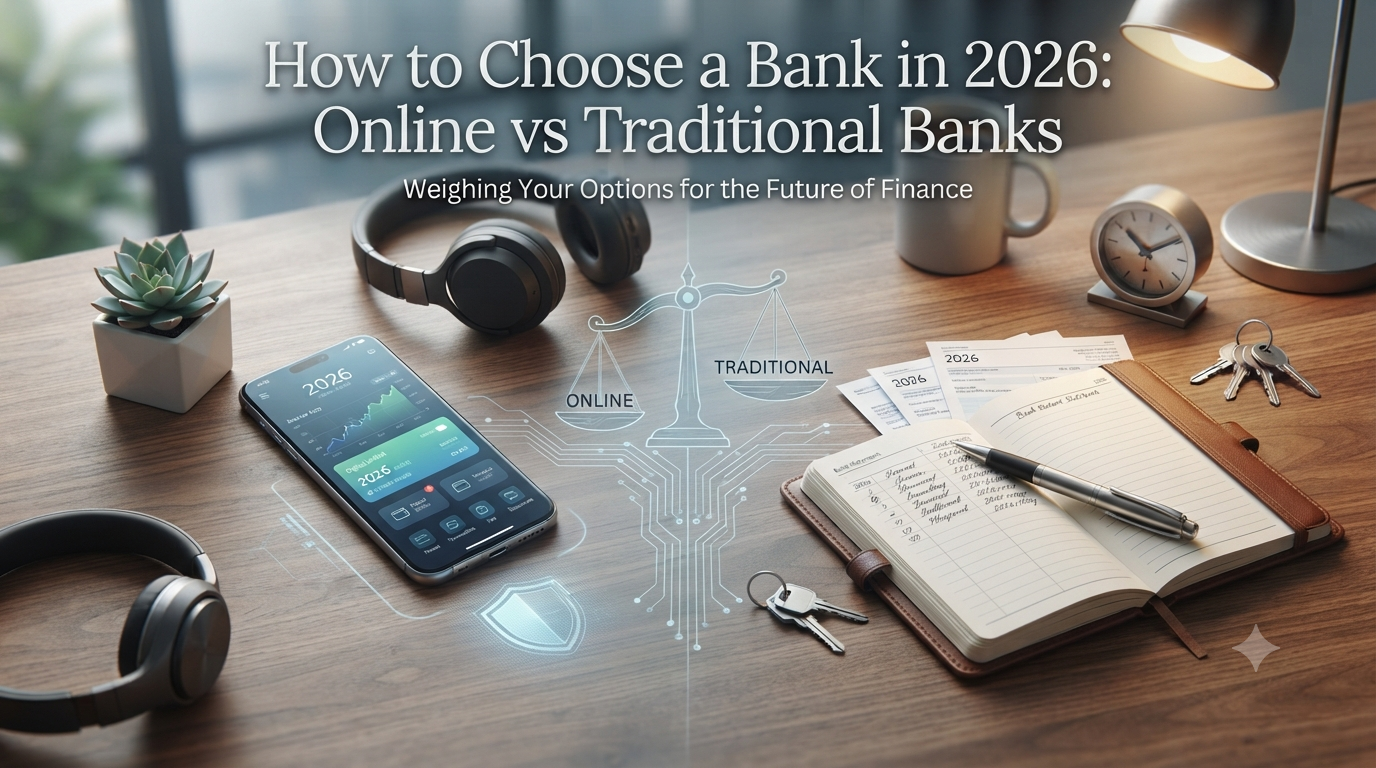
There are more banking options available now than at almost any point before, and that’s both a good thing and a source of genuine decision fatigue. Learning how to choose a bank in 2026 mostly comes down to one core trade-off: online banks routinely offer higher interest rates and lower fees than traditional branch-based banks, but they come with trade-offs that matter for some people more than others — and picking the wrong fit can mean paying unnecessary fees for years without realizing it.
This guide breaks down exactly how online and traditional banks differ, what to actually compare before choosing, and how to decide based on your specific situation. If you haven’t yet decided which account type to open first, our companion guide on checking vs savings accounts is worth reading alongside this one.

Online Banks vs Traditional Banks — Core Differences
Online Banks — Pros and Cons
Online banks operate without physical branches, which lets them pass on lower overhead costs to customers in the form of higher savings interest rates and fewer monthly fees. The trade-off is the absence of in-person service — no branch to walk into for a complex issue, and cash deposits can be more cumbersome, sometimes requiring a trip to a partner ATM network or a mail-in deposit process.
Traditional Banks — Pros and Cons
Traditional banks offer physical branches and, often, a wider network of ATMs, along with the ability to speak with someone face-to-face for more complicated banking needs. The trade-off is typically lower interest rates on savings and a higher likelihood of monthly maintenance fees, since branch networks come with real operating costs that get passed on to customers in some form.
What to Compare Before Choosing
Fees and Minimum Balances
Look closely at monthly maintenance fees, minimum balance requirements, and whether those fees are waived under certain conditions like direct deposit. Some banks — particularly online ones — offer no-fee accounts with no minimum balance at all, which removes an entire category of consideration.
Interest Rates on Savings
Interest rates on savings accounts can vary enormously between online and traditional banks, sometimes by a significant multiple. Even a modest balance can accumulate a meaningfully different amount of interest over a year depending on which type of bank you choose, so this is worth comparing directly rather than assuming all banks offer similar rates.
ATM and Branch Access
If you regularly handle cash, or you prefer being able to walk into a branch for account issues, this factor might outweigh the interest rate difference entirely. Some online banks partner with large ATM networks to offset the lack of physical branches, which is worth checking specifically rather than assuming all online banks handle this the same way. The FDIC’s BankFind tool is a useful independent way to confirm a bank’s insurance status and basic details before opening an account anywhere.
Mobile App and Digital Tools
Since online banks operate primarily through their app, the quality of that app matters enormously for day-to-day usability. Even traditional banks vary widely in how good their digital tools are, so it’s worth checking reviews and, if possible, trying the app before committing to a full account switch.

Which Is Better for Beginners?
For most people just starting out, an online bank with no fees, no minimum balance, and a strong mobile app tends to be the more forgiving choice, since it removes several of the ways beginners commonly lose money to avoidable fees. That said, if you anticipate needing frequent in-person support, handle a lot of cash, or simply feel more comfortable with a physical branch nearby, a traditional bank isn’t the wrong choice — it’s just a different set of trade-offs that might suit your comfort level better even if it costs slightly more in fees or lost interest.
Can You Use Both Together?
Yes, and this is actually a common setup among people who’ve thought through the trade-offs carefully. A frequent approach is keeping a checking account at a traditional bank for in-person access and cash handling, while keeping a savings account at an online bank to take advantage of significantly higher interest rates. Since transfers between banks are usually straightforward, even if not always instant, this hybrid setup lets you capture the benefits of both without fully committing to either one.
How Your Bank Choice Affects Building Credit
Your bank choice doesn’t directly affect your credit score, since checking and savings accounts aren’t typically reported to credit bureaus at all. But the bank you choose often affects which credit-building products are available to you — some banks offer secured cards or credit-builder loans specifically to their existing customers, sometimes with preferential terms. For the bigger picture of how banking fits into building credit from the ground up, see our complete guide on how to build credit from scratch.
Choosing an Account Type First
If you haven’t yet decided whether to prioritize a checking or savings account, that decision is worth making before you settle on a specific bank, since it affects which features matter most in your comparison. Our guide on checking vs savings account: which do you need first walks through exactly how to make that call based on your situation.
Automating Savings With the Right Bank
Once you’ve settled on a bank, setting up automatic transfers into savings is one of the most effective habits you can build early on, and the process looks a little different depending on whether you’ve chosen an online or traditional bank. Our step-by-step guide on how to automate your savings covers exactly how to set this up regardless of which type of bank you land on.
FAQs
Are online banks as safe as traditional banks? Generally yes, as long as the online bank is FDIC-insured (or NCUA-insured for credit unions), which provides the same deposit protection as a traditional bank up to the standard coverage limits.
Can I deposit cash into an online bank account? It depends on the bank. Some partner with retail networks or allow deposits through partner ATMs, while others require alternative methods like mobile check deposit or transfers from another account, since they don’t operate branches directly.
Do online banks have worse customer service than traditional banks? Not necessarily worse, just different — most online banks offer phone, chat, or email support instead of in-person service, and many have highly rated support experiences despite the lack of physical branches.
Is it hard to switch banks once I’ve already opened an account? It’s more of an administrative task than a difficult one — updating direct deposit information and any automatic payments is usually the most time-consuming part, but most banks offer switch kits or guides to help streamline the process.
Should I choose my bank based on interest rates alone? Interest rates matter, especially for savings, but fees, access, and app quality often have a bigger day-to-day impact on your experience than a rate difference of a fraction of a percent, particularly if your balance is still relatively small.
Conclusion
Deciding how to choose a bank in 2026 really comes down to weighing convenience against cost: online banks generally win on fees and interest rates, while traditional banks win on in-person access and cash handling. For many people, especially beginners, a no-fee online bank is the more forgiving starting point, though a hybrid approach using both isn’t unusual once you understand the trade-offs.
Whichever you choose, the account type you open and the habits you build from there — particularly automating your savings — matter more in the long run than which specific bank logo appears on your card.
This article is for informational purposes only and does not constitute financial advice. Consult a qualified financial advisor for guidance specific to your situation.
Author: Personal Finance Editorial Team — covering practical credit-building and banking guidance for readers starting from any financial background.