
On This Page
- What’s the Difference Between Hardware and Software Wallets?
- Hardware Wallets — Pros and Cons
- Software Wallets — Pros and Cons
- Security Comparison
- Cost Comparison
- Which One Should You Choose?
- Can You Use Both Together?
- FAQs
Best Crypto Wallets 2026: Hardware vs Software — Which Should You Choose?
Sooner or later, almost everyone who spends real time in crypto runs into this exact question: should I move my funds to a hardware wallet, or is a software wallet good enough? It’s one of the most common debates in the space, and the honest answer is that it depends heavily on how much you’re holding and what you’re actually doing with it.
This guide breaks down the real differences between hardware and software wallets — not just in theory, but in terms of what actually changes in your day-to-day experience, your security exposure, and your costs. By the end, you should have a clear sense of which one fits your situation, or whether you actually need both. For a broader look at wallet types in general, see our complete crypto wallet comparison guide.
What’s the Difference Between Hardware and Software Wallets?
The core difference comes down to where your private keys are stored and whether they ever touch the internet.
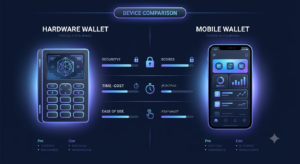
A hardware wallet is a physical device — often resembling a small USB drive — that generates and stores your private keys completely offline. Even when you connect it to a computer or phone to approve a transaction, the keys themselves never leave the device. This is why hardware wallets are often called “cold storage.”
A software wallet exists as an app on your phone, computer, or as a browser extension. Your private keys are stored on that device, encrypted, but the device itself is connected to the internet, which is why these are referred to as “hot wallets.”
Neither type is inherently “the” answer for everyone — they’re built for different priorities: hardware wallets prioritize security above all else, while software wallets prioritize convenience and speed.
Hardware Wallets — Pros and Cons
Pros:
- Private keys never touch an internet-connected device, making remote hacking extremely difficult
- Immune to most malware and phishing attempts that specifically target software wallets
- Ideal for storing larger amounts you don’t need to access frequently
- Often includes a physical confirmation step (a button press on the device) that prevents malicious software from silently approving transactions
Cons:
- Less convenient for frequent transactions or active DeFi use
- Requires an upfront purchase cost
- Can be lost, damaged, or stolen as a physical object (though recovery is still possible with your seed phrase)
- Slightly steeper learning curve for complete beginners
Best Hardware Wallets in 2026
Look for a device with an established track record, open-source firmware or a public security audit history, and support for the specific chains you hold. Screen-equipped models that let you verify transaction details directly on the device (rather than trusting what’s shown on a connected computer or phone) offer an extra layer of protection against a compromised host device.
For independent, non-commercial background on how cold storage devices generate and isolate private keys, Bitcoin.org’s wallet security overview is a useful reference.
Software Wallets — Pros and Cons
Pros:
- Free to download and set up in minutes
- Ideal for frequent transactions, active trading, and DeFi interaction
- Built-in dApp browsers make connecting to decentralized platforms simple
- Easy to use across multiple devices
Cons:
- Connected to the internet, which creates more exposure to malware, phishing, and compromised devices
- A compromised phone or computer can potentially expose your wallet
- Browser extension wallets can be targeted by fake, cloned extensions
Best Software Wallets in 2026
Prioritize a wallet with a strong security track record, biometric or PIN protection, and — ideally — the option to pair with a hardware wallet for larger transactions. If DeFi access matters to you, revisit our guide on best wallets for decentralized finance for the specific features that matter most in that context.

Security Comparison: Cold Storage vs Hot Wallets
The security difference between these two options isn’t just theoretical — it shows up in the actual attack methods used against each.
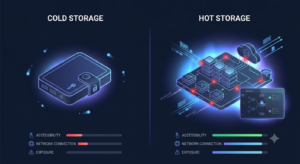
Hot wallets are more exposed to remote attacks: phishing sites designed to trick you into entering your recovery phrase, malware that scans device memory for private keys, and fake browser extensions mimicking legitimate wallets. Because the wallet is always connected, an attacker doesn’t need physical access to your device to potentially compromise it.
Cold storage wallets remove most of that exposure by keeping keys fully offline. The realistic threats shift instead toward physical security — theft of the device itself, or user error like storing a written recovery phrase somewhere unsafe. For most users, this trade-off favors hardware wallets once holdings reach a meaningful value, simply because remote attacks are far more common and scalable for attackers than physical ones.
Cost Comparison
Software wallets are free in the overwhelming majority of cases — the wallet provider makes money through optional in-app swap fees rather than charging for the app itself. Hardware wallets require an upfront purchase, which varies depending on the model and features, but functions as a one-time cost rather than an ongoing expense.
When weighing this cost, it helps to think about it relative to what you’re protecting. A one-time device purchase that meaningfully reduces your risk of losing funds to a remote attack is generally a reasonable trade-off once your holdings pass a certain threshold — even if that exact threshold is a personal judgment call rather than a fixed number.
Which One Should You Choose? (Decision Framework)
For Long-Term Holders
If you’re holding assets for months or years without needing frequent access, a hardware wallet is almost always the safer choice. The minor inconvenience of plugging in a device occasionally is a small trade-off for significantly reduced exposure to remote attacks.
For Active Traders
If you’re moving funds frequently — trading, rebalancing, or reacting to market conditions in real time — a software wallet’s speed and convenience usually outweighs the security trade-off, provided you’re using strong device security practices and keeping only what you actively need on hand.
For DeFi Users
DeFi users often land somewhere in between: using a software wallet for day-to-day interaction with protocols, while keeping the bulk of their holdings in a hardware wallet and only moving smaller amounts over for active use. Our guides on best wallets for decentralized finance and best wallets for earning DeFi rewards go deeper into structuring this kind of setup.
Can You Use Both Together? (Hybrid Approach)
Yes, and for a lot of experienced users, this ends up being the most practical long-term setup. Many hardware wallets can connect to a companion software wallet or browser extension, letting you get hardware-level key security while still interacting with DeFi platforms, dApps, and decentralized exchanges through a familiar software interface.
In practice, this often looks like: the majority of long-term holdings kept in the hardware wallet, with a smaller, active balance kept in a software wallet for day-to-day transactions and DeFi participation. This way, even if the software wallet or the device it’s on is ever compromised, only the smaller active balance is at risk — not your full holdings.
FAQs
Is a hardware wallet completely hack-proof? No wallet is completely immune to every possible attack, but hardware wallets remove the most common attack vector — remote access over the internet — by keeping private keys offline at all times.
Can I lose access to my funds if my hardware wallet breaks? No, as long as you’ve securely stored your recovery phrase. The device itself doesn’t hold your funds; it holds the keys, which can be restored onto a new device using your recovery phrase.
Do I need a hardware wallet if I only hold a small amount of crypto? Not necessarily. For smaller balances, the added security may not outweigh the convenience trade-off. It becomes more worthwhile as your holdings grow to an amount where losing them would be a significant loss.
Can I use a hardware wallet for DeFi? Yes, most hardware wallets can connect to DeFi platforms through a companion software wallet or browser extension, combining offline key storage with the ability to interact with smart contracts.
Which is better for beginners, hardware or software wallets? Software wallets are generally easier to start with due to their simple setup process. As holdings grow or usage becomes more serious, transitioning to a hardware wallet — or using both together — becomes a natural next step.
Conclusion
When it comes to the best crypto wallets, hardware vs software isn’t a question with a universal winner — the right choice depends on how much you’re holding, how often you need access, and how much convenience you’re willing to trade for added security. Long-term holders benefit most from hardware wallets, active traders and DeFi users often lean on software wallets for daily use, and many experienced users land on a hybrid approach that gets the best of both.
Whichever you choose, the fundamentals stay the same: protect your recovery phrase, verify everything you’re approving, and match your wallet setup to how you actually use crypto — not just what sounds the most secure on paper.
This article is for informational purposes only and does not constitute financial advice. Always research any device or wallet provider independently before making a purchase.
Author: Crypto & Finance Editorial Team — researching and reviewing crypto tools since the early days of DeFi, with a focus on practical, jargon-free guidance for everyday users.